Source Interactive Whiteboard for Classrooms, Meetings, and Training
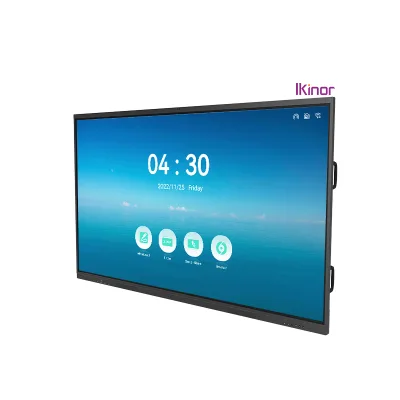
Compare 30 Interactive Whiteboard options with sizes from 55 to 110 inches and resolutions up to 4K. Buyers can evaluate specs like RAM, ROM, and touch points from suppliers in China.
Key considerations
Products List

Hot Selling Interactive 4K Interactive Smartboard Interactive Whiteboard
$339.00 - $359.00
MOQ: 1 Pieces

65 Inch Screen Touch Educational and Office Equipment Interactive Whiteboard
$460.00 - $500.00
MOQ: 3 Pieces


Interactive Smart Board Interactive Whiteboard Educational Smart Board Panel
$550.00 - $680.00
MOQ: 1 Pieces


Interactive Whiteboard with Touch Screen for Education and Conference
$2000.00 - $2500.00
MOQ: 5 Pieces

Interactive Whiteboard with Infrared Touch System for Education and Conference
$2000.00 - $2500.00
MOQ: 5 Pieces


Easy Installation Smart Whiteboard Dual OS Whiteboard Android Whiteboard
$399.00 - $1380.00
MOQ: 1 Pieces


Comprehensive Sourcing Guide
Strategic Sourcing Guide for Interactive Whiteboard Procurement
Understanding the Core Product Architecture and Technical Variability
The Interactive Whiteboard represents a critical convergence of display technology and touch input systems, designed primarily for collaborative environments in education and corporate settings. When evaluating this category, buyers must recognize that the product is not a monolithic unit but a collection of configurations defined by specific hardware and software attributes. The fundamental architecture relies on a glass substrate, which serves as the primary display surface. This material choice is consistent across the observed inventory, offering durability and clarity essential for high-usage scenarios.
A primary differentiator in this category is the touch technology employed. The market data indicates a prevalence of infrared touch principles, which utilize a frame of sensors to detect the position of a finger or any opaque object. This technology supports multi-touch capabilities, with observed specifications ranging up to 20 touch points. This capacity allows multiple users to interact with the display simultaneously, a feature that is vital for brainstorming sessions and collaborative learning. The system supports various input methods, including fingers and opaque objects, ensuring flexibility in different usage environments.
The display dimensions are a significant variable in the procurement process. Buyers should expect a wide range of sizes, typically spanning from 55 inches up to 110 inches, with specific models available in 55, 65, 75, 85, 86, and 98-inch configurations. The resolution is a critical performance metric, with 4K resolution being a standard high-confidence attribute for modern units. This resolution ensures that text and graphics remain sharp and legible from a distance, which is essential for large meeting rooms or classrooms.
The internal computing architecture is equally diverse. Processors vary from specific model identifiers like V100 and 3576 to general descriptions such as Octa-Core. Memory configurations are equally flexible, with Random Access Memory (RAM) options ranging from 8GB to 64GB and Read-Only Memory (ROM) storage spanning from 128GB to 1TB. This variability allows buyers to match the device's processing power to their specific workload, whether it involves basic presentation playback or complex interactive application usage. Operating systems are another key decision point, with Android 11.0, Android 12, and Android 14 being observed, alongside Windows compatibility via OPS (Open Pluggable Specification) modules. Connectivity is robust, featuring dual-band Wi-Fi (2.4GHz/5GHz), built-in Bluetooth, and in some configurations, 3G/4G mobile network support.
Compliance, Certification, and Regulatory Standards
Navigating the regulatory landscape is a non-negotiable aspect of sourcing interactive whiteboards, particularly for international procurement. The supply chain for these devices often originates from China, as indicated by the product origin data. To ensure market access and safety compliance, buyers must verify that the units carry recognized certifications. The observed data highlights several key certifications, including RoHS (Restriction of Hazardous Substances), CCC (China Compulsory Certification), CE (Conformité Européenne), and ISO standards.
While specific certification statuses for every individual unit cannot be guaranteed without direct verification, the presence of these marks in the product metadata suggests a baseline of compliance with international safety and environmental standards. RoHS compliance ensures that the device does not contain hazardous materials such as lead or mercury, which is crucial for environmental regulations in the European Union and other jurisdictions. The CE mark indicates conformity with health, safety, and environmental protection standards for products sold within the European Economic Area. Similarly, the CCC mark is mandatory for products sold within mainland China, serving as a baseline for domestic quality and safety.
Buyers should treat these certifications as verification points rather than automatic guarantees. It is essential to request current certification documents from the supplier to confirm that the specific batch of goods being purchased meets the latest regulatory requirements. The product standards observed, such as dimensions like 1693969 and 151.510.393.6cm, provide physical benchmarks but do not replace the need for electrical and safety compliance verification. Ensuring that the device meets the specific regulatory needs of the target market is a primary responsibility of the procurement team to avoid customs delays or legal liabilities.
Cost Drivers and Pricing Dynamics
The pricing structure for interactive whiteboards is highly variable, reflecting the wide spectrum of specifications and customization options available. The observed price range spans from $0.35 to $6,962 USD. This vast disparity is not indicative of quality variance alone but rather reflects the inclusion of different components, sizes, and optional features. The lower end of the spectrum may correspond to specific accessories, smaller components, or base models with minimal specifications, while the upper end likely represents fully configured, large-format units with premium specifications.
Several factors drive the final cost of the unit. First, the screen size is a primary cost driver; larger panels, such as the 86-inch or 110-inch models, naturally command higher prices due to the increased material and manufacturing costs. Second, the internal hardware configuration significantly impacts pricing. Units with higher RAM (e.g., 64GB) and larger ROM (e.g., 1TB), coupled with more powerful CPUs, will be priced higher than entry-level models with 8GB RAM and 128GB storage. Third, the operating system and software ecosystem play a role; devices with pre-installed, licensed versions of Android or Windows, or those with advanced interactive software suites, will carry a premium.
Customization is another major cost variable. The product data indicates that customization is available, allowing buyers to tailor the device to specific branding or functional needs. However, the data also notes that some units are listed as "Non-Customized." Customized orders typically involve higher Minimum Order Quantities (MOQ) and longer lead times, which can influence the unit cost. The observed MOQ range of 1 to 100 units suggests that buyers can source single units for pilot testing or bulk orders for large-scale deployment. Buyers must carefully evaluate the total cost of ownership, including the price of optional accessories like mobile stands, wall mounts, and cameras, which are listed as optional features.
Typical Applications and Deployment Scenarios
Interactive whiteboards are versatile tools designed to enhance collaboration and information delivery across various sectors. The primary application is in the education sector, where the 20-point multi-touch capability and 4K resolution support interactive learning. Teachers and students can annotate, draw, and manipulate digital content simultaneously, transforming passive lectures into active learning experiences. The availability of Android and Windows operating systems allows for the use of a wide range of educational software, ensuring compatibility with existing digital curricula.
In the corporate environment, these devices serve as central hubs for meetings and presentations. The ability to mount the unit on a wall or place it on a mobile stand offers flexibility in room layout. The mobile stand option, described as "Movable With Rack," is particularly useful for organizations that need to move the display between conference rooms or use it in temporary setups. The large screen sizes, up to 110 inches, ensure that content is visible to all participants in large boardrooms, while the high resolution ensures that detailed data and graphics are rendered clearly.
The durability of the glass surface and the infrared touch technology make these units suitable for high-traffic public spaces, such as lobbies, museums, and training centers. The ability to touch the screen with any opaque object, including styluses or even a hand, adds to their versatility in public-facing applications. The operating temperature range of 0-40℃ ensures reliable performance in standard indoor environments, though buyers should verify specific environmental requirements for extreme climates. The inclusion of a 1-year warranty provides a baseline of protection for these investments, covering potential manufacturing defects or hardware failures during the initial period of use.
Supplier Evaluation and Quality Assurance Protocols
Evaluating suppliers for interactive whiteboards requires a rigorous approach to ensure product reliability and service quality. Buyers should prioritize suppliers who can provide clear documentation regarding the product's origin, manufacturing standards, and quality control processes. The observation that products are "New" and in "Stock" suggests immediate availability, but buyers must verify the condition of the goods upon delivery to ensure they meet the "New" status claim.
Quality control should focus on the physical integrity of the glass panel, the accuracy of the touch response, and the stability of the operating system. Buyers should request sample units for testing before committing to large orders, especially when the MOQ is low. The testing should include checking the touch sensitivity across the entire screen, verifying the resolution and color accuracy, and ensuring that the Wi-Fi and Bluetooth connectivity are stable. The lead time, observed to range from 7 to 40 days, should be factored into the procurement timeline, with buffer time added for potential delays in shipping or customs clearance.
Packaging is another critical aspect of quality assurance. The product data indicates that units are packed in cartons, with specific dimensions provided for some models. Buyers should ensure that the packaging is robust enough to protect the large glass panels during transit. The inclusion of a mobile bracket or wall mounting hardware in the package should be verified to ensure all necessary components are present. Suppliers who offer comprehensive after-sales support, including technical assistance and spare parts availability, are preferable for long-term procurement relationships.
Long-Term Procurement and Operational Considerations
Sourcing interactive whiteboards is not just a one-time transaction but a long-term investment that requires careful planning for maintenance and scalability. The warranty period, typically 1 year, is a critical factor in the initial procurement decision. Buyers should consider the cost and terms of extended warranty options, as these devices are subject to wear and tear from frequent use. The availability of replacement parts, such as touch sensors or power supplies, should be confirmed to ensure minimal downtime in case of failure.
Scalability is another important consideration for organizations planning to deploy multiple units. The ability to customize the device and the availability of different sizes allow for a phased rollout strategy. Buyers should also consider the software ecosystem; ensuring that the chosen operating system (Android or Windows) is compatible with existing enterprise software and management tools is essential for seamless integration. The dual-band Wi-Fi and mobile network support provide flexibility in network deployment, allowing the devices to function in various connectivity environments.
Finally, buyers should monitor the market for technological advancements and updates. The rapid evolution of touch technology and operating systems means that today's cutting-edge device may become obsolete in a few years. Procuring units with upgradable components or modular designs can extend the useful life of the investment. By focusing on these long-term factors, organizations can ensure that their Interactive Whiteboard procurement delivers sustained value and supports their collaborative goals for years to come.
Comparative Analysis of Key Specifications
To assist buyers in making informed decisions, the following table summarizes the key specifications observed in the market data. This comparison highlights the variability in models and helps identify the features that align with specific procurement needs.
| Feature Category | Observed Options | Typical Use Case |
|---|---|---|
| Screen Size | 55, 65, 75, 85, 86, 98, 110 Inch | Small classrooms to large boardrooms |
| Touch Technology | Infrared Induction, Multi-Touch (up to 20 points) | Collaborative brainstorming, education |
| Operating System | Android 11.0, 12, 14; Windows (via OPS) | General purpose, enterprise integration |
| Memory (RAM) | 8GB, 16GB, 32GB, 64GB | Basic display to heavy multitasking |
| Storage (ROM) | 128GB, 256GB, 512GB, 1TB | Standard apps to extensive media libraries |
| Connectivity | Dual Band WiFi, Bluetooth, 3G/4G (Optional) | Network flexibility, remote access |
| Mounting | Wall Mounted, Mobile Stand (Movable With Rack) | Fixed installations, flexible room layouts |
| Certifications | RoHS, CCC, CE, ISO | Compliance for EU, China, and global markets |
| Warranty | 1 Year | Standard protection period |
This table serves as a reference for buyers to quickly assess the technical landscape. It underscores the importance of matching specific hardware configurations to the intended application, ensuring that the procurement decision is data-driven and aligned with operational requirements. By carefully analyzing these specifications, buyers can navigate the complex market of interactive whiteboards with confidence and precision.
FAQs
What touch technology do these interactive whiteboards use?
These units primarily utilize infrared touch principles that detect fingers or any opaque objects. The system supports multi-touch capabilities with up to 20 touch points for simultaneous interaction by multiple users.
Which operating systems are available for these displays?
The devices come with Android versions including 11.0, 12, and 14, alongside Windows compatibility via OPS modules. This flexibility allows users to run diverse applications suitable for both education and corporate environments.
How large are the screen size options available?
Screen sizes range from 55 inches up to 110 inches, with specific models available in 55, 65, 75, 85, 86, and 98-inch configurations. This variety ensures suitable display dimensions for different room sizes and usage scenarios.
Can I customize the Interactive Whiteboard for my brand?
Customization is available for specific orders, allowing for tailored branding or functional needs. However, some units are listed as non-customized, and customized options may involve different minimum order quantities and lead times.
What is the warranty period for these products?
The standard warranty period provided is one year, covering potential manufacturing defects or hardware failures. Buyers should consider extended warranty options for long-term protection against wear and tear from frequent usage.
Which certifications do these whiteboards typically hold?
Products often carry certifications such as RoHS, CCC, CE, and ISO to ensure compliance with international safety standards. Buyers must verify current certification documents for specific batches to meet target market regulatory requirements.
How long is the typical lead time for delivery?
The observed lead time ranges from 7 to 40 days depending on order volume and customization. This duration should be factored into procurement timelines with buffer time added for potential shipping or customs delays.